The short answer
The crystal is the clear cover over the dial. Acrylic is a light plastic that scratches easily but rarely shatters. Mineral is hardened glass and resists everyday scratches better. Sapphire is the hardest of the three, rating 9 out of 10 on the Mohs hardness scale, so very little in daily life will scratch it.
The three types side by side
| Acrylic | Mineral | Sapphire | |
|---|---|---|---|
| What it is | Clear plastic | Hardened glass | Lab-grown sapphire |
| Scratch resistance | Low | Medium | Very high |
| If it takes a hard knock | Tends to flex or crack, rarely shatters | Can chip or shatter | Can chip or shatter |
| Light scratches | Can often be polished out | Usually there to stay | Rare in normal wear |
| Where you see it most | Pocket watches and vintage-style watches | Most everyday watches | Watches built for harder wear |
No type is simply the best. Each one trades scratch resistance against how it handles a knock, and against cost.
Acrylic crystal
Acrylic is a clear plastic, sometimes called plexiglass. It is light, it can be shaped into a high dome, and it gives a watch a warm, traditional look. That is why it is still common on pocket watches.
Its weak point is scratching. Keys, zips and a rough tabletop can all leave marks. The good news is that light marks sit on the surface and can often be buffed out with a polish made for plastic watch crystals. A jeweler can do this for you if you would rather not try it. Acrylic also stands up well to a knock, because it gives a little instead of shattering.
Mineral crystal
Mineral crystal is glass that has been hardened, usually by heat or a chemical treatment. It is the most common crystal on watches today. It resists scratches much better than acrylic and stays clear for years of normal wear.
It is not scratch-proof. Sand and grit are a common cause of marks, because they contain quartz, which is harder than glass. A scratch in mineral crystal usually can't be polished out at home, and a hard knock on an edge can chip or crack it. If that happens, a watch repairer can replace the crystal.
Sapphire crystal
Sapphire crystal is made from sapphire grown in a lab, not from glass. It rates 9 on the Mohs hardness scale, where diamond is 10. In daily wear, very few things are hard enough to scratch it, so it keeps its clear, new look the longest.
Hard does not mean unbreakable. Sapphire can still chip or shatter if it takes a sharp blow. It also reflects more light than glass, so some makers add an anti-reflective coating. Makers differ on this, so check the watch's own details.
Which one should you choose?
- You are hard on your watches or hate scratches: sapphire.
- You want a dependable everyday watch: mineral does the job well.
- You like a traditional look, or you are choosing a pocket watch: acrylic is normal and easy to keep looking good.
A hunter-case pocket watch adds its own protection, since a metal lid covers the crystal when the watch is closed. Our guide to hunter, half hunter and open face pocket watches explains the styles.
How to tell which crystal a watch has
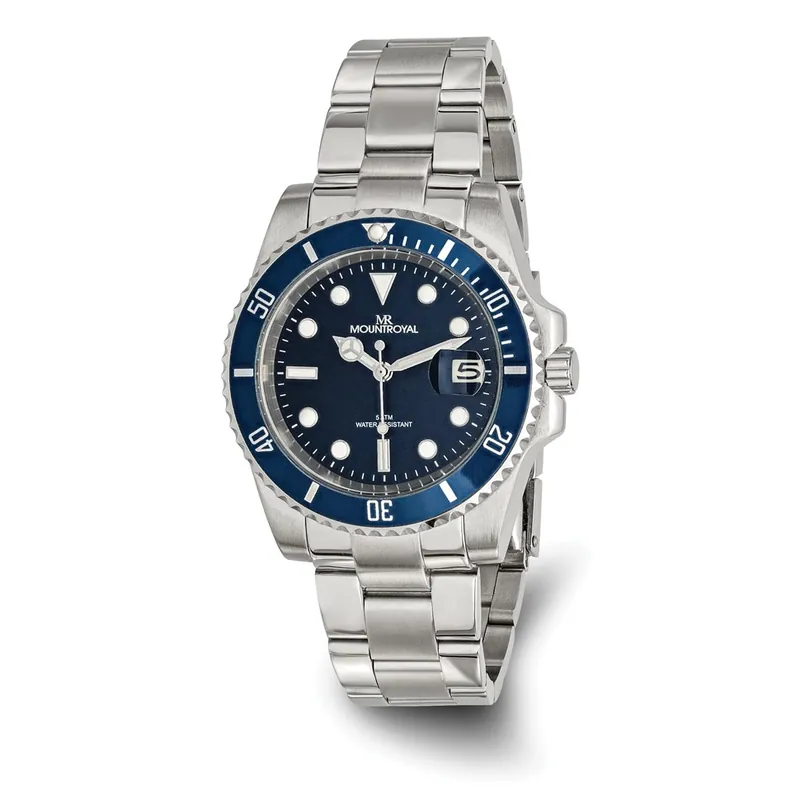
The surest way is to read the specs. Every watch we carry lists its crystal on its product page. Most of our wrist watches have mineral crystal, a smaller group have sapphire, and most of our pocket watches have acrylic. The watch pictured here, a blue dial model with a rotating bezel, has a sapphire crystal.
Looking after any crystal
- Wipe it with a soft, clean cloth. Grit on a cloth can scratch.
- Take your watch off for rough jobs, the beach and the gym.
- Don't put it in a pocket or bag with keys or coins.
- If the crystal cracks or chips, stop wearing the watch until it is fixed. A damaged crystal can let in dust and water, whatever the water resistance rating says.
For the rest of the watch, see how to clean a watch at home.