The short answer
A skeleton watch has its dial, and often parts of the movement, cut away so you can see the gears and balance wheel at work. Most are mechanical, either hand-wound or automatic, because the moving parts are the point. They are harder to read at a glance than a solid dial, so look for hands that contrast with the movement behind them.
What you are looking at
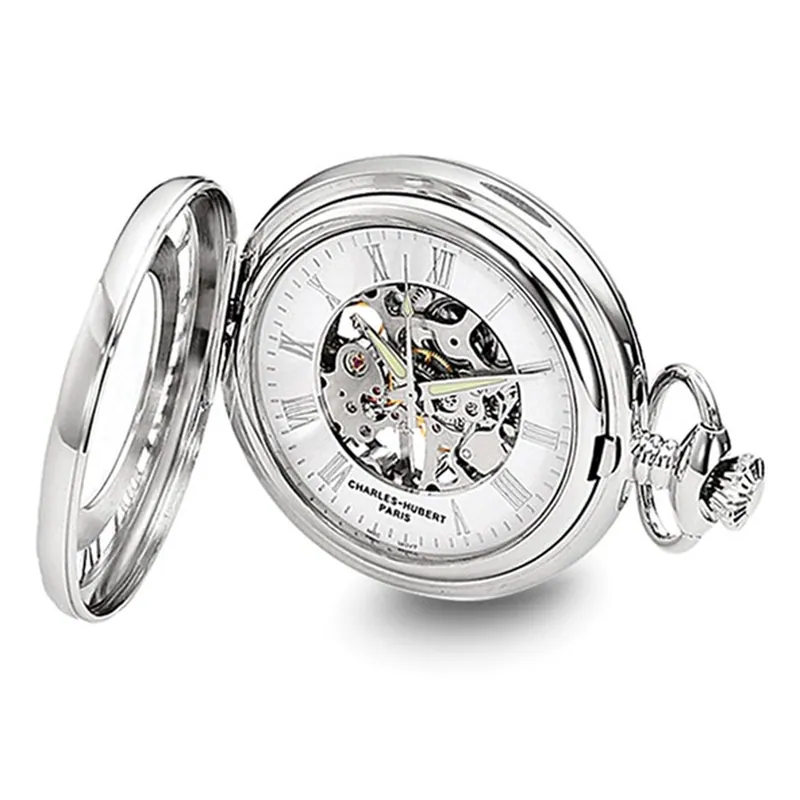
Through a skeleton dial you can usually see a few parts move:
- The balance wheel, which swings back and forth several times a second. Its steady beat is what keeps time.
- The mainspring barrel, a round drum that holds the wound spring and releases its power slowly.
- The gear train, the wheels that carry that power to the hands.
- Jewels, small red synthetic stones that act as low-friction bearings. A watch listed as 17 jewel has 17 of them.
Skeleton, open heart and exhibition back
| Style | What you see |
|---|---|
| Skeleton | Most of the dial is cut away, often with openwork plates, so much of the movement shows from the front |
| Open heart | A solid dial with one small window, usually over the balance wheel |
| Exhibition case back | A clear back, so the movement shows from behind; it can come with any dial |
Makers use these terms loosely, so check the photos as well as the name.
Reading the time
The busy background is the trade-off. Hands that contrast with the movement, such as dark hands over a light movement, or luminous hands, are much easier to read. Roman numerals on a ring around the edge help too.
Caring for a skeleton watch
- Wind or wear it. A hand-wound watch needs winding about once a day; see how to wind and set a pocket watch. An automatic winds as you wear it, and a winder can keep it running when you don't; see do you need a watch winder.
- Keep it dry unless the watch's own rating says otherwise.
- Keep it away from strong magnets, which can make a mechanical watch run fast.
For how mechanical movements compare with quartz, read quartz vs automatic vs mechanical.
Pocket or wrist
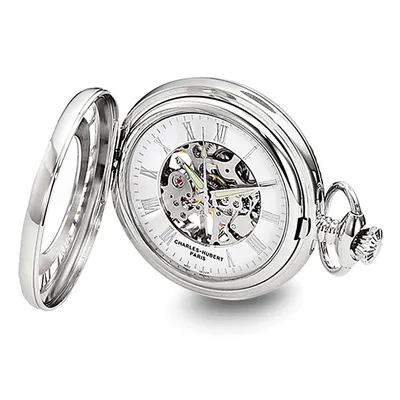
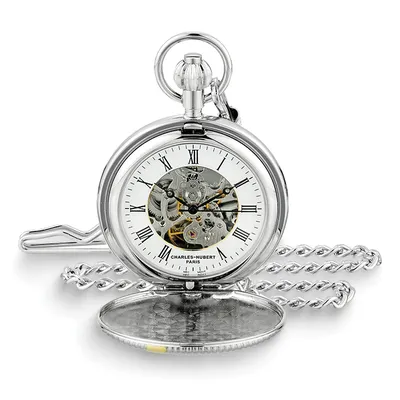
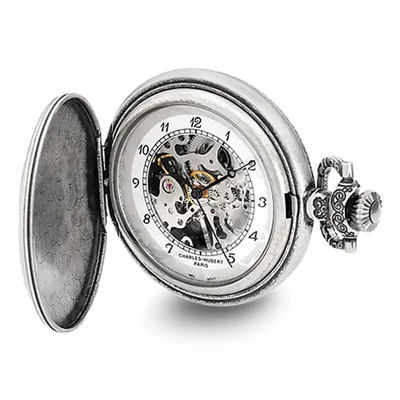
Skeleton dials suit pocket watches well, since you take the watch out to look at it anyway. The Charles Hubert hunter case pocket watch with a white skeleton dial is one example: a 47 mm case, a hand-wound 17-jewel mechanical movement, luminous hands, Roman numerals and an acrylic crystal, with a cover that protects the dial in a pocket. Browse our skeleton dial pocket watches, or read about hunter and open face cases.